The Left Brain / Right Brain Split Is a Great Story. It's Also Mostly Fiction.
The Left Brain / Right Brain Split Is a Great Story. It's Also Mostly Fiction.
At some point, you've probably been told — or told yourself — that you're a left-brained person. Logical. Analytical. Good with numbers. Or maybe you've claimed the right-brain identity: creative, intuitive, more comfortable with feelings than formulas. It's a tidy way to explain yourself at a dinner party, and it has the satisfying ring of something scientific.
There's just one problem. Neuroscientists largely stopped taking this framework seriously decades ago. The left-brain/right-brain split, as most people understand it, is one of the more durable pieces of pop psychology ever to escape from a research lab — and the gap between what the science actually showed and what the culture ran with is genuinely fascinating.
The Real Discovery That Started It All
The story begins with legitimate, Nobel Prize-winning science, which is part of why it's so sticky.
In the 1960s, neuroscientist Roger Sperry and his colleague Michael Gazzaniga conducted groundbreaking research on patients who had undergone a procedure called a corpus callosotomy — a surgery that severed the corpus callosum, the thick bundle of nerve fibers connecting the brain's two hemispheres. The surgery was used to treat severe epilepsy, and Sperry's team discovered something remarkable: when the two hemispheres couldn't communicate, they behaved in measurably different ways.
In these "split-brain" patients, the left hemisphere appeared more involved in language and logical processing. The right hemisphere showed greater engagement with spatial reasoning and the recognition of patterns. Sperry won the Nobel Prize in Physiology or Medicine in 1981 for this work, and the discovery was real, important, and carefully qualified.
Then the pop psychology machine got hold of it.
How a Qualified Finding Became a Personality Type
By the 1970s and 1980s, the nuanced findings from a small group of surgical patients had been stretched into a sweeping theory of human personality. Books declared that schools were failing right-brained children. Corporations ran training seminars to help employees "activate" their weaker hemisphere. Personality quizzes promised to reveal which side of your brain was dominant — and by extension, who you fundamentally were as a person.
The appeal is understandable. Human beings love categories, especially ones that feel scientific. Left brain vs. right brain gave people a framework for understanding themselves and others that felt grounded in biology. It also arrived at a moment when brain research was capturing public imagination, and the media was hungry for accessible explanations of complex neuroscience.
But there were serious problems with the leap from Sperry's findings to the cultural myth that followed.
First, Sperry's subjects were not typical brains. They were patients who had undergone an unusual and significant surgical procedure. Conclusions drawn from split-brain patients don't automatically transfer to people with intact, fully connected brains — and in connected brains, the two hemispheres are in constant, rapid communication.
Second, the specific functions attributed to each side were oversimplified almost immediately. Language does tend to lateralize to the left hemisphere in most right-handed people — but "logical thinking" and "creativity" are not discrete functions that live in one place. They're distributed processes involving networks spread across both hemispheres.
What Modern Neuroscience Actually Shows
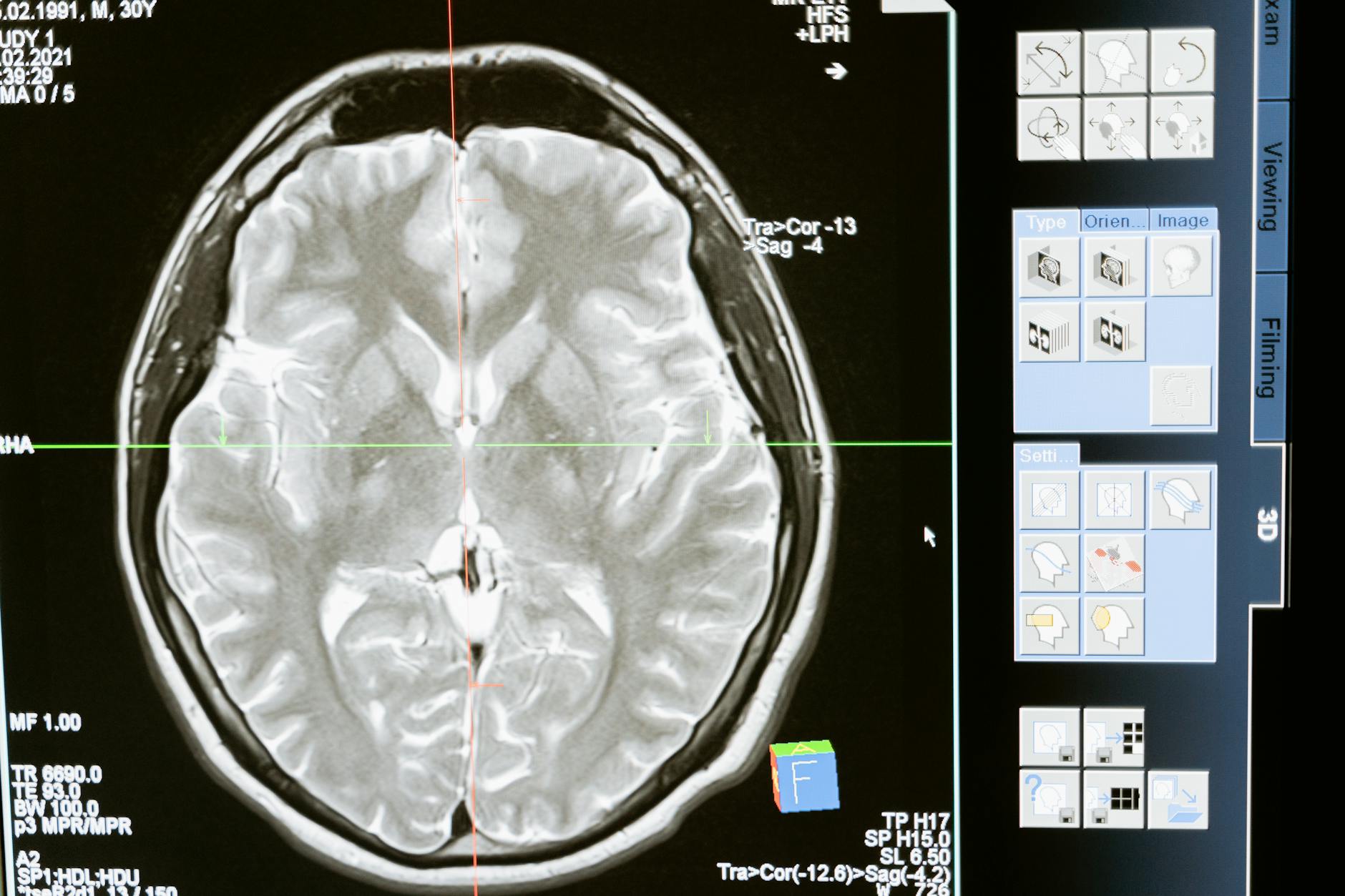
Advances in neuroimaging — particularly fMRI technology, which can show brain activity in real time — have given researchers a far more detailed picture of how the brain actually works during complex tasks.
A large-scale study published in 2013 by researchers at the University of Utah analyzed brain scans from over 1,000 people and found no evidence that individuals consistently use one hemisphere more than the other. People don't have a dominant hemisphere in any meaningful, personality-shaping sense. The brain operates as an integrated system, with different regions and networks activating in coordination depending on what you're doing.
Creativity, it turns out, is a particularly instructive example. Far from being a "right brain" function, creative thinking appears to involve a complex interplay between multiple brain networks — including the default mode network (active during imagination and daydreaming), the executive control network (involved in focus and evaluation), and the salience network (which helps switch between them). These networks span both hemispheres and work together in ways that the left/right binary simply cannot capture.
The same is true for analytical thinking. Mathematical reasoning, logical problem-solving, and language processing all involve bilateral brain activity, not a single hemisphere working in isolation.
Why the Myth Is So Hard to Let Go
Simplification is the engine of misconception, and the left-brain/right-brain model is a prime example of a real finding being simplified past the point of accuracy. Once an idea becomes embedded in educational materials, personality assessments, and everyday conversation, it develops a kind of cultural momentum that facts alone can't easily stop.
There's also the matter of identity. People have built self-understanding around these labels. Telling someone that their "right-brained creative" identity isn't biologically grounded can feel like a personal challenge, not just a factual correction.
And to be fair, the underlying intuition isn't entirely wrong. People do differ in their cognitive strengths and tendencies. Some people are more drawn to analytical tasks; others gravitate toward creative ones. The error isn't in noticing human variation — it's in mapping that variation onto a tidy anatomical split that the brain doesn't actually observe.
What This Means for How You Think About Yourself
The more accurate picture is also, arguably, a more freeing one. If creativity and analytical thinking aren't locked into separate hemispheres, then they're not fixed traits distributed unequally between people. They're both capacities that exist in every healthy brain, shaped by experience, practice, and context.
You are not your hemisphere. You are a person with a remarkably integrated, adaptable brain that does not sort its functions into two neat columns.
The real takeaway: Left-brain/right-brain dominance is a cultural myth built on a real but misapplied scientific discovery. Modern neuroscience shows the brain functions as a deeply connected system, and creativity and logic aren't housed on opposite sides of anything. You don't have to pick a team.