That Number in the Corner of Your Phone Screen Is a Polite Fiction
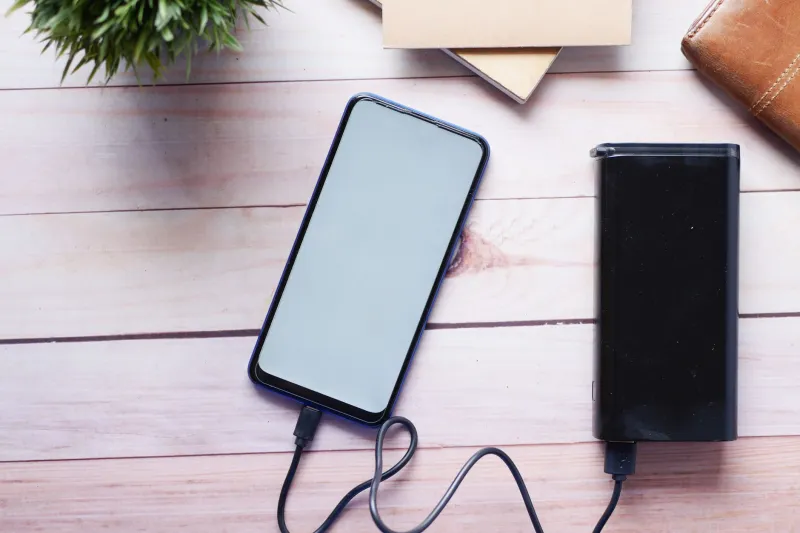
At some point, almost everyone has watched their phone drop from 20% to dead in about four minutes. You plug it in, furious, convinced the battery is shot. But here's the thing: your battery probably isn't as broken as you think. The percentage you've been trusting was never quite telling you the whole truth to begin with.
What You Think That Number Means
Most people treat the battery percentage like a gas gauge — a direct, real-time reading of how much energy is left. Thirty percent means you've used seventy percent. Zero means empty. It seems like a simple measurement of a simple thing.
But lithium-ion batteries — the kind in every modern smartphone — don't work like a gas tank. They work more like a sponge that gets harder to squeeze the longer you hold it. The relationship between charge level and available voltage is a curve, not a straight line, and that curve behaves very differently at the top and bottom of the range.
How Batteries Actually Discharge
Here's what's actually happening inside your phone. Lithium-ion cells deliver power by moving lithium ions between two electrodes. When the battery is full, that process is efficient and relatively stable. As the charge drops, the voltage delivered by the cell starts to fall — slowly at first, then more steeply as it approaches the bottom of its range.
The problem is that your phone's processor, screen, and radios need a relatively stable voltage to function. Once the battery voltage drops below a certain threshold, the phone can't operate — even if there are technically lithium ions still left to move. That's the engineering reality. The phone doesn't die because it's completely empty. It dies because the remaining energy can no longer be delivered at a usable voltage.
This is why a phone can sit at 15% for an hour and then fall off a cliff. The voltage curve is steep at the bottom, and once you cross that threshold, things move fast.
The Hidden Buffer You Don't Know About
To manage this, manufacturers don't actually let you use the full capacity of your battery. On most smartphones, a portion of the total battery capacity is locked off at both ends — a buffer at the top to reduce stress on the cells during charging, and a buffer at the bottom to prevent the kind of deep discharge that permanently damages lithium-ion chemistry.
What this means in practice is that when your phone reads 100%, it probably charged to somewhere around 80–85% of the cell's true maximum. And when it reads 0%, there's still a small amount of charge left — just not enough to run the phone at normal operating voltage.
You're essentially renting the middle portion of your battery. The edges belong to the manufacturer, and for good reason: letting you drain a lithium-ion cell completely, repeatedly, would destroy it within months.
So Where Does the Percentage Come From?
The battery percentage is calculated by a small chip called a fuel gauge IC — essentially a microcontroller that monitors voltage, temperature, current flow, and historical charge cycles to estimate how much usable energy remains. It's doing sophisticated math in real time, but it's still an estimate.
That estimate gets less accurate over time. As a battery ages, its internal resistance increases and its capacity shrinks. The fuel gauge has to recalibrate constantly, and it doesn't always keep up. This is why an older phone might report 30% and then shut down — the gauge is working off outdated assumptions about what the battery can actually deliver.
Apple, Samsung, and other manufacturers have all updated their battery management software over the years specifically to improve how gracefully phones handle this degradation. But no software patch fully solves the underlying physics.
Why This Misconception Persists
Partly because the percentage works most of the time. For the bulk of daily use — say, between 80% and 30% — the estimate is accurate enough that you'd never notice the gap between the number and reality. It's only at the edges, and especially as a battery ages, that the polite fiction starts to break down.
There's also the fact that manufacturers have little incentive to explain this in detail. Telling customers that the battery percentage is an approximation and that you can't really use the full stated capacity doesn't make for great marketing copy.
What You Should Actually Do With This Information
A few practical things follow from understanding how this actually works.
First, if your phone is dying unexpectedly at 15–20%, it doesn't necessarily mean the battery needs immediate replacement. It might just mean the fuel gauge is miscalibrated. Running the battery down to zero and then charging it fully — once, not regularly — can help recalibrate the gauge on some devices.
Second, keeping your phone between roughly 20% and 80% extends battery lifespan more than almost anything else you can do. The buffers manufacturers build in help, but the less time your battery spends at the extremes, the longer it lasts.
Third, the battery health percentage buried in your phone's settings (visible in Settings > Battery on iPhone, for example) is actually a more meaningful number than the daily readout. That figure reflects how much of the original capacity your battery can still hold — and once it drops below around 80%, the inaccuracies in your daily percentage tend to get noticeably worse.
The Takeaway
Your battery percentage is a useful approximation built on real-time calculations, engineering buffers, and some carefully managed expectations. It's not a lie, exactly — but it's not a precise measurement either. The next time your phone dies at 18%, the battery probably isn't broken. The number just finally ran out of room to be optimistic.